
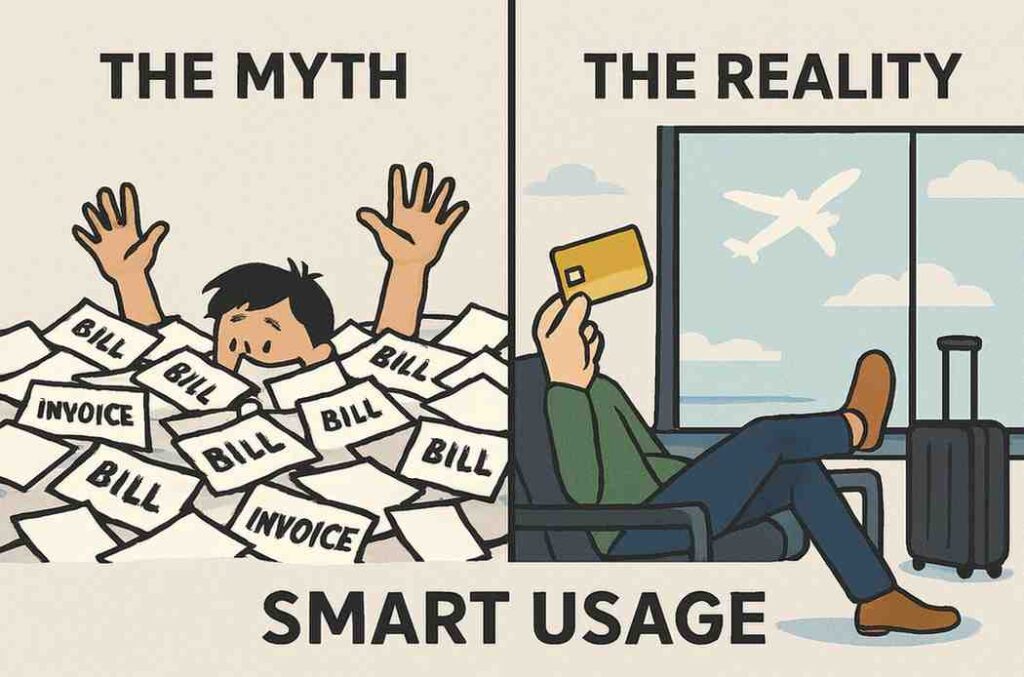
If you go to your parents and tell them, “Dad, I want to get a Credit Card,” there is a 90% chance they will say “No.” In middle-class Indian families, Credit Cards are often seen as a trap. We have heard horror stories of people who spent too much money, got stuck in debt, and had recovery agents knocking on their doors. Because of these stories, most young professionals stick to their Debit Cards and fear the word “Credit.”
However, the truth is that a Credit Card is like a sharp knife. In the hands of a chef, a knife creates a delicious meal. In the hands of a fool, it causes an injury. The problem is not the card; the problem is the lack of financial education. If used correctly, a Credit Card is the most powerful financial tool in your wallet. It can give you free flights, cashback on shopping, and an interest-free loan for 45 days. In this beginner’s guide, we will destroy the common myths and teach you the “Golden Rules” of using plastic money safely.
Debit Card vs. Credit Card: The Big Difference
To understand why you need a Credit Card, you first need to understand how it is different from a Debit Card. When you swipe your Debit Card, the money is instantly cut from your bank account. You are spending your own hard-earned money. If your account is empty, the transaction fails.
When you swipe a Credit Card, you are not spending your money. You are spending the Bank’s money. The bank pays the shopkeeper on your behalf, and you promise to pay the bank back after a specific period (usually 45 to 50 days). This is the biggest advantage. Your own money stays in your bank account earning interest for 50 days, while you use the bank’s money for free. Also, Credit Cards offer better security. If a hacker steals your Debit Card info and steals money, your real cash is gone. But if they hack your Credit Card, you can simply report it to the bank, and since it was the bank’s money, they will fight the fraud case, not you.
The “Minimum Due” Trap
This is the number one reason why people fall into debt. When your Credit Card bill comes at the end of the month, it shows two numbers:
Total Amount Due: (e.g., ₹10,000)
Minimum Amount Due: (e.g., ₹500)
Many beginners see the ₹500 and think, “Wow, I only have to pay this much?” This is a trap. The “Minimum Due” is just a small fee to keep your card active. If you pay only the minimum, the remaining ₹9,500 will attract a massive interest rate of 30% to 40% per year. Golden Rule: Always, always pay the “Total Amount Due.” If you cannot afford to pay the full bill, do not swipe the card in the first place.
Debit Card vs. Credit Card
| Feature | Debit Card | Credit Card |
| Source of Money | Your Bank Account | Bank’s Loan Limit |
| Interest Free Period | None (Instant Cut) | Up to 45-50 Days |
| Rewards/Cashback | Very Low | High |
| Builds CIBIL Score | No | Yes (Very Important) |
| Risk | Your Money at Risk | Bank’s Money at Risk |
Earning While You Spend
The reason rich people love Credit Cards is “Rewards.” Every time you swipe your card, the bank earns a commission from the shopkeeper. To encourage you to swipe more, the bank shares a part of this profit with you in the form of Reward Points or Cashback.
Imagine you spend ₹10,000 on groceries every month. If you use cash or UPI, you spend ₹10,000 and get nothing back. If you use a Cashback Credit Card (like Amazon Pay ICICI or Flipkart Axis), you might get 5% cashback. That is ₹500 saved instantly. Over a year, this adds up to ₹6,000. Just by changing your payment method, you earned money. Many premium cards also offer “Lounge Access,” which means you get free food and comfortable seating at airports, which otherwise costs thousands of rupees.
Common Myths That Scare People
There are many rumors about credit cards that stop people from applying. Let’s bust them. One common myth is that “Having too many cards is bad.” This is false. If you have three cards and you manage them well, it actually improves your Credit Score because it shows you can handle multiple credit lines. Another myth is “Credit Cards have hidden charges.” While this can be true, most charges are mentioned in the “Most Important Terms and Conditions” (MITC) document. If you get a “Lifetime Free” card, there is no annual fee. If you pay on time, there is no late fee. The charges only apply if you break the rules.
Truth vs. Myth
| Myth (False) | Truth (Real) |
| Credit Cards make you spend more. | You control the spending, not the card. |
| You need a high salary to get one. | You can get one against a Fixed Deposit (FD) too. |
| It ruins your credit score. | Used correctly, it is the fastest way to build a score. |
| Interest is charged from Day 1. | No, interest is 0% if you pay the full bill by the due date. |
How to Choose Your First Card
Do not just accept the first card a bank agent offers you over the phone. Choosing the wrong card can cost you money. As a beginner, your priority should be a “Lifetime Free” card. This means there is no Joining Fee and no Annual Fee.
For Shopping: Amazon Pay ICICI or Flipkart Axis Bank card.
For Fuel: BPCL or IndianOil co-branded cards.
For General Use: HDFC Millennia or SBI SimplyCLICK.
Check the “Default Rate” (interest rate) and the “Late Payment Fee” before signing. Also, ensure the card has an easy-to-use mobile app so you can track your expenses daily.
The Golden Rules of Usage
| Rule | Explanation |
| The 30% Rule | Never use more than 30% of your total limit. |
| The Full Payment Rule | Ignore the “Minimum Due.” Pay 100% of the bill. |
| The No-Cash Rule | NEVER withdraw cash from an ATM using a Credit Card. (High Interest). |
| The Alert Rule | Keep SMS/Email alerts on for every transaction. |
Conclusion
A Credit Card is not good or bad; it is neutral. It is simply a tool. If you lack self-control and treat the credit limit as “free money,” you will fall into a debt trap. But if you treat it as a “payment method” and pay your bills like a disciplined soldier, it will reward you with free vacations, cashback, and a strong CIBIL score. The choice is yours. Be a master of the card, not its slave.
Become financially smart with SatJobz.
FAQs
Q1. What happens if I miss the due date by one day?
You will be charged a “Late Payment Fee” (usually ₹500-₹1000) and interest on the total amount. Plus, your CIBIL score will drop. Always set an Auto-Pay reminder.
Q2. Can I transfer money from Credit Card to Bank Account?
Technically yes, using third-party apps, but it attracts high charges (1% to 3%). Avoid doing this unless it is a medical emergency.
Q3. What is “Cash Withdrawal” interest?
If you withdraw cash from an ATM using a Credit Card, the bank charges interest (approx 3-4% per month) from that very second. There is no interest-free period for cash withdrawals.
(Disclaimer: This article is for educational purposes only. Credit Cards involve financial risk. Please read the terms and conditions of the bank carefully before applying.)

admin
Expert content creator dedicated to providing authentic educational and career updates.