
Every year, around January and February, HR departments across India send a scary email to all employees: “Please declare your Tax Regime and submit investment proofs.” For most young professionals, this email causes panic. You stare at the screen, seeing two options—Old Regime and New Regime—and you have no idea which one to click. You ask your colleague, and he says “Old is gold.” You ask your other friend, and she says “New is simple.” Who is right?
Making the wrong choice here can cost you anywhere from ₹10,000 to ₹50,000 in extra taxes. That is money you could have saved for your vacation or investment. In this simple guide, we will strip away the complex Chartered Accountant language and explain exactly which regime puts more money in your pocket based on your salary.
The Fundamental Difference
To understand the difference, imagine you are buying a Pizza.
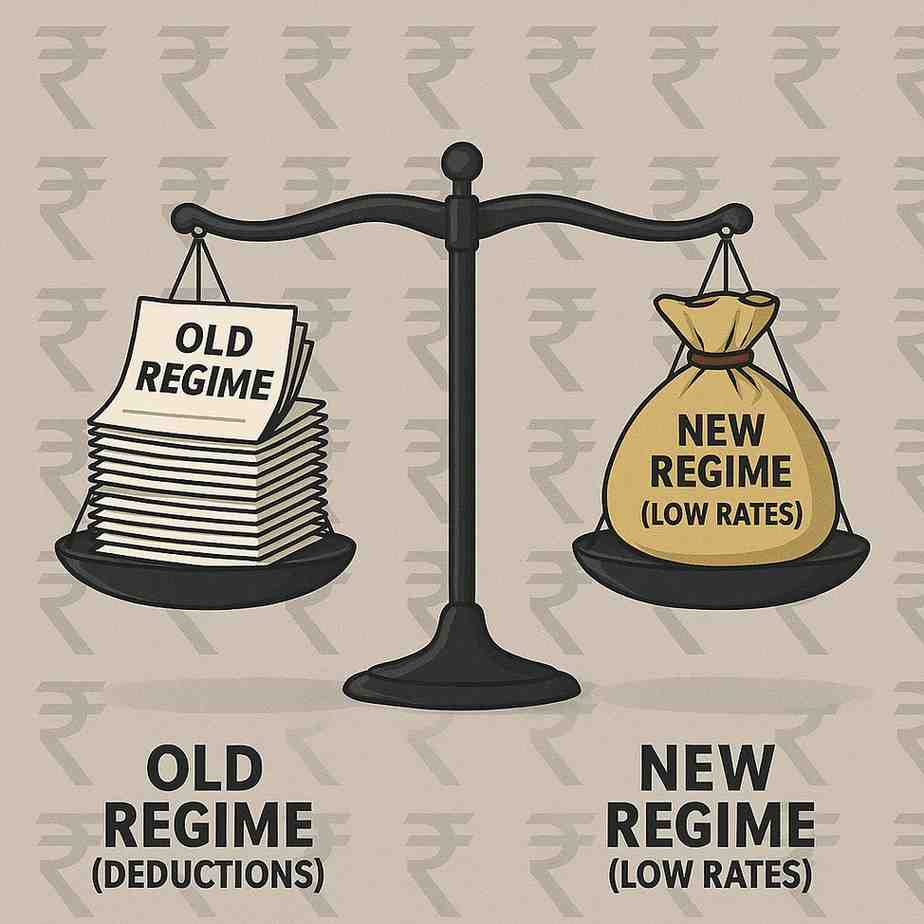
The Old Regime is like a “Coupon Code” system. The Pizza price is high (High Tax Rates). However, the shopkeeper allows you to apply many coupons.
“Show School Fee Receipt? Get ₹10 off.”
“Show Rent Receipt? Get ₹20 off.”
“Show Insurance Policy? Get ₹15 off.” If you have all these coupons (Deductions), the final price of the pizza becomes very low. But collecting these receipts requires effort and paperwork.
The New Regime is like a “Flat Discount” system. The shopkeeper says, “Forget the coupons. I will give you the Pizza at a lower price directly.” The Tax Rates are lower from the start. But you are not allowed to use any coupons. You cannot claim Rent, Insurance, or Loan deductions. It is simple, paperless, and hassle-free.
The “Coupon” List (Deductions in Old Regime)
The Old Regime is beneficial ONLY if you use these major weapons (Sections) to reduce your taxable income:
Section 80C (The Big One): You can hide up to ₹1.5 Lakhs from tax by investing in EPF, PPF, or ELSS Mutual Funds.
Section 80D (Health): Money paid for Health Insurance premiums (up to ₹25,000 for self, more for parents).
HRA (House Rent Allowance): If you live in a rented house, a huge chunk of your salary becomes tax-free.
Section 24(b) (Home Loan): If you are paying EMI for a home loan, you get a massive deduction on the interest paid.
If you do NOT have these expenses (e.g., you live with parents and don’t invest), the Old Regime is useless for you.
👉 Read : Best Mutual Funds to Save Tax (SIP Guide)
Feature Smackdown
| Feature | Old Regime | New Regime |
| Tax Rates | High (Up to 30% quickly) | Low (Gradual increase) |
| Paperwork | Very High (Need Proofs) | Zero (No Proofs) |
| 7 Lakh Limit | Taxable | Tax Free (Rebate u/s 87A) |
| Exemptions | HRA, LTA, 80C allowed | Not Allowed |
| Standard Deduction | ₹50,000 Allowed | ₹50,000 Allowed |
The 7 Lakh Magic Number
The government wants to push everyone towards the New Regime. To do this, they have played a masterstroke. Under the New Regime, if your taxable income is up to ₹7 Lakhs, you pay ZERO TAX. Yes, ₹0. If your salary is ₹7.5 Lakhs, you get a standard deduction of ₹50,000, bringing income to ₹7 Lakhs. Result? Zero Tax.
However, in the Old Regime, the rebate limit is lower (₹5 Lakhs). Verdict: If your annual income is below ₹7.5 Lakhs, blindly choose the New Regime. Do not calculate anything. Just pick New and enjoy your full salary.
When Should You Stick to Old Regime?
The Old Regime fights back when your salary is high (above ₹10-12 Lakhs) AND you have high expenses. You should strictly choose Old Regime if your total deductions (HRA + 80C + 80D) exceed ₹3.75 Lakhs.
Example:
You pay ₹1.5 Lakh in LIC/PF (80C).
You pay ₹50,000 Health Insurance (80D).
You pay ₹2 Lakhs as House Rent (HRA).
Total Deduction: ₹4 Lakhs. Since ₹4 Lakhs > ₹3.75 Lakhs, the Old Regime will save you more money.
👉 Read: Why You Need Health Insurance (Emergency Fund)
Which One to Pick? (Quick Guide)
| Your Profile | Recommended Regime |
| Fresher (Salary < ₹7.5 Lakhs) | New Regime (Zero Tax) |
| Living with Parents (No Rent) | New Regime (Simple) |
| Living on Rent + Investing (80C) | Old Regime (High Savings) |
| Having Home Loan + Salary > ₹15L | Old Regime (Best) |
How to Switch?
Many employees fear that if they choose one option, they are stuck forever. Good News: As a salaried employee, you can choose a different regime every year. If you paid rent this year, choose Old. If you shift to your own house next year, choose New. However, you have to tell your employer (HR) at the start of the year so they deduct TDS accordingly. If you forget to tell them, the government has made New Regime the Default option.
Common Deductions Cheat Sheet (Old Regime Only)
| Section | Purpose | Max Limit |
| 80C | PF, ELSS, Life Insurance | ₹1.5 Lakh |
| 80D | Medical Insurance | ₹25k – ₹50k |
| 80E | Education Loan Interest | Unlimited |
| 80CCD(1B) | NPS (National Pension) | Extra ₹50,000 |
| 24(b) | Home Loan Interest | ₹2 Lakhs |
Conclusion
Tax planning is not about evading tax; it is about optimizing it. Don’t be lazy. Spending 30 minutes calculating your tax can save you ₹30,000.
Go for New Regime if you want simplicity and earn less than ₹15 Lakhs without major loans/rent.
Go for Old Regime if you are a disciplined investor living in a rented house.
The best regime is the one that leaves more money in your bank account.
Save smart with SatJobz.
FAQs
Q1. Can I switch regimes while filing ITR? Yes! Even if you told your HR you want New Regime, you can switch to Old Regime while filing your final ITR in July, provided you have all the investment proofs ready.
Q2. Is Standard Deduction available in New Regime? Yes, from FY 2023-24 onwards, the Standard Deduction of ₹50,000 is available in BOTH Old and New Regimes.
Q3. Which regime is better for freelancers? Freelancers (Business/Professionals) can only switch regimes once in a lifetime. Once they opt out of the New Regime, they cannot easily come back. They need to be very careful compared to salaried employees.
(Disclaimer: Tax laws are subject to change in every Budget. This article is based on current rules. Please consult a CA for personal tax filing.)

admin
Expert content creator dedicated to providing authentic educational and career updates.